

Showing posts with label written by Shirshendu Mukhopadhyay. Show all posts
Showing posts with label written by Shirshendu Mukhopadhyay. Show all posts
Tuesday, February 27, 2018
Eagler Chokh


Sunday, May 28, 2017
Wrin

A rich heiress gets murdered at her own residence after giving a party
on her return home from America. She was stabbed with knife twice. The murderer
breaks several perfume pots to confuse the sniffer dogs. Thousands of dollars
are stolen from her purse.
But was theft the only motive? Was it not revenge by her divorced
husband who had been insulted long time back and now is the sole custodian to
the immense wealth by quite a curious turn of events? Or is it the cousin, the
next of kin, a shy lady who apparently inherits the riches suddenly.
But as Sabar investigates several important points turn up. The dead
father seems to have a secret of his own. The diary of the victim seems to provide
more insight to her thoughts as it changed over the years. There is also a
seemingly comic friend, a characterless yet avid womanizer, who seemed to have
some feelings for the victim. There is also a lover with whom she eloped at the
prime of her life but did not continue. Finally there is a mysterious lady who was
seen with many but nobody seems to know her correctly.
A thrilling suspense based on human psychology that is smartly woven but
a snag remained as to how the identity of the mysterious lady was converged as
there was never any clear way to establish whether it was one lady or two
ladies.
But it is really a satisfying novel from an
author less knows for mystery fictions. After completing it there will surely be
yearning for more like it.
Sunday, April 09, 2017
Rup-Mareech Rahasya

This is one of those books which I read after seeing the detective on screen. Though the couple of stories that are included here is not that is televised still, but it has not been disappointment. Sabar investigates murders in both and solves it in his signature style which is unique than many standard sleuth stories. The analyst in Sabr gathers the intel through his sources but mainly his main emphasis is on the psychology of the crimes which allows him to pinpoint the criminals. The style of the story is again a wonderful variant of the author where dialogues are only used to narrate the story. The sinister ambience is created in a signature style that is not only thrilling but intelligent as well. Infact the first story Rup has a classic twist finally that reveals the human Sabar and the second one Mareech shows how nobly ruthless Sabar can be. A nice volume that will actually prompt the readers to keep up with more sleuthing stories.
Wednesday, May 18, 2016
Bhuteder Niie Goppo

Sieving thru the bookself searching for something different, suddenly this one caught the eyes. Standing in a forgotten corner was my childhood's happy companion whose contents run as
• Raat Jakhan Barota
• Kustir Pyanch
• Nishi Kabrej• Kogramer Madhupandit
• Dui Paloan
• Purano Jinish
• Nayanchand
Though these are for the children, yet they brought a sense of nostalgia and fun devoid of malice. Chiefly belonging to the ghost genre but some are exceptions that are no less entertaining. This, for a change, brought some fond moments back once more.
Monday, May 06, 2013
Wednesday, April 17, 2013
Friday, April 05, 2013
Goynar Baksho

Eager
with the curiosity of what the story is all about that is to be brought
to screen recently I started reading the novel and surprising myself, I
finished it at record pace. This has been my first approach to
Shirshendu's stories for the adult and I became more obsessed to
continue reading his stories of the genre as I completed this. A story
encompassing three generations, the style that is followed, has at once
kept the readers engrossed, not only by its content but also in the
element of surprise. Written from the perspective of two ladies the plot
has unfolded itself centering a jewellery box left in the possession of
apparently the least likely family member. Curiously enough the story
consists of ghost but the seriousness of the central theme has not at
all compromised. The finale is also reminiscent of a classic where the
readers know what the culmination is but the subtlety is reserved for
the imaginative ones. The virtues of generations contrasting with
frustrations and worries, the decaying Bengalee nobility with their
false ego, the spirit of the present generation, the confusions
surrounding true romance, all had been sketched to perfection to bring
out a grand orchestra. Being a fan of his stories for the young, I once
more fell in love with the works of Mukhopadhyay, this time for the
older readers.
Saturday, September 08, 2012
Batukburoro Chashma
The story seemed Golmaal revisited 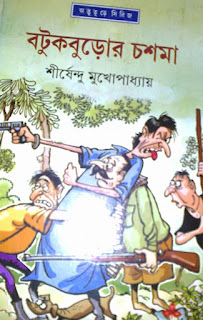 but with more pace and more fun. The characters too seemed more amusing. The sudden appearance of green beings (literally and figuratively speaking), initially in village gossips and then in the real seemed to disturb the peaceful lives of many. Showing superior intelligence and strength, the sapient beings (remember Avatar by James Cameron!) seemed to condemn destruction of flora and fauna. Their technology, science, philosophy seemed to dwarf that of the globe, yet their requirements are simple. So why did they come here? What do they want? Is there an evil motive? Why are they so keen to communicate? To know all these you must go through the novel which sometimes jumps sequences but remains exciting throughout with its lovable characters, each showing a curious trait.
 but with more pace and more fun. The characters too seemed more amusing. The sudden appearance of green beings (literally and figuratively speaking), initially in village gossips and then in the real seemed to disturb the peaceful lives of many. Showing superior intelligence and strength, the sapient beings (remember Avatar by James Cameron!) seemed to condemn destruction of flora and fauna. Their technology, science, philosophy seemed to dwarf that of the globe, yet their requirements are simple. So why did they come here? What do they want? Is there an evil motive? Why are they so keen to communicate? To know all these you must go through the novel which sometimes jumps sequences but remains exciting throughout with its lovable characters, each showing a curious trait.
Tuesday, June 26, 2012
Doshti Kishore Upanyas
This compilation for the young contains
- Gourer Kaboch
- Harano Kakatua
- Golmaal
- Chakrapurer Chakkare

- Chhayamoe
- Sonar Medal
- Patalghar
- Haripurer Harek Kando
- Dudhsayarer Dweep
- Bipinbabur Bipod

Sunday, November 27, 2011
Pagla Saheber Kabar

The seemingly good-for-nothing Haribandhu was admitted much against his wish to a reformatory school at Motiganja so as to improve on his academic skills that seem to be limited to only Bengali poetry. As he started his days on the new school, from the very first day onwards, he seemed to be on the wrath of several of the older students whose ragging continued even after school hours and outside the school premises. Only one of his classmates, Gopal befriended him and protected him from the rest. Haribandhu also was offerred wisdom from Patal, apparently a common thief, but possessed wondrous martial arts' skills.  Above all these was the mysterious mad Englishman - a legend - nobody knew whether he was living or dead - who appeared on his galloping white horse whenever somebody at Motiganja needed help. Infact he saved Haribandhu on several occassions. The presence of this apparition not only intrigued Haribandhu but also his legend haunted him likewise. Queer people seemed to protect the legend from sinister forces at Motiganja. Several attempts were made on the life of Haribandu and his well wishers. As Hari tried hard to cope with these along with the snags in his studies suddenly he finds himself central to everybody's attentions. Can he understand the reason for these and will he manage to do the undoable? As the plot gradually unfolds, the author presents an enjoyable adventure for both the old and the young!
 Above all these was the mysterious mad Englishman - a legend - nobody knew whether he was living or dead - who appeared on his galloping white horse whenever somebody at Motiganja needed help. Infact he saved Haribandhu on several occassions. The presence of this apparition not only intrigued Haribandhu but also his legend haunted him likewise. Queer people seemed to protect the legend from sinister forces at Motiganja. Several attempts were made on the life of Haribandu and his well wishers. As Hari tried hard to cope with these along with the snags in his studies suddenly he finds himself central to everybody's attentions. Can he understand the reason for these and will he manage to do the undoable? As the plot gradually unfolds, the author presents an enjoyable adventure for both the old and the young!
Wednesday, October 12, 2011
Hirer Angti
The
story starts with the common thief Sasthi planning on robbing a stranger of his
priceless  diamond ring. But as he learnt that the person is would be guest of
the revered and respectable Ratan Banerjee, he pauses for a moment in his
endeavour. But the lust for the ring seemed to get the better of his self as he
conspires with others to steal it anyhow. However, surprises seemed in store
for him and his comrades as not only did they fail three times in a row, but each
time their own possession changes hands. As the infuriated Sasthi, bent on
revenge, enters the feared boundary of the Banerjee mansions he becomes witness
to yet another revelation, that of a possible treachery and assassination. The adventures
that follows him and the inmates of Banerjee mansion remains to be enjoyed by
the reader, both old and young, but one thing is certain - Shirshendu had once more penned an
entertainer filled with thrill, wit, suspense and humour. Essentially
categorized as children’s book, with a varied mix of strange characters abound,
the story is crisp, compact and enjoyable with an underline message,
beautifully conveyed for readers of all age.
 diamond ring. But as he learnt that the person is would be guest of
the revered and respectable Ratan Banerjee, he pauses for a moment in his
endeavour. But the lust for the ring seemed to get the better of his self as he
conspires with others to steal it anyhow. However, surprises seemed in store
for him and his comrades as not only did they fail three times in a row, but each
time their own possession changes hands. As the infuriated Sasthi, bent on
revenge, enters the feared boundary of the Banerjee mansions he becomes witness
to yet another revelation, that of a possible treachery and assassination. The adventures
that follows him and the inmates of Banerjee mansion remains to be enjoyed by
the reader, both old and young, but one thing is certain - Shirshendu had once more penned an
entertainer filled with thrill, wit, suspense and humour. Essentially
categorized as children’s book, with a varied mix of strange characters abound,
the story is crisp, compact and enjoyable with an underline message,
beautifully conveyed for readers of all age.
Tuesday, July 26, 2011
Gourer Kabach
In my childhood days, the story "Gourer Kabach" used to fascinate me due to its queer mix of comic incidents in a tragic backdrop, the matter-of-fact way in which the eccentric people are introduced, the simpleness of the protagonist Gour and finally the good prevailing over the bad.  Maybe I would have felt the same had it not been the fact that certain points came to my notice this time. The most prominent being the overwhelming amount of printing errors that have marred the entire novel and is very much irritating for an avid reader. Next is the abruptness of the final chapter that also doesn't seem to satisfy the minds that are a bit more oldish among its target of young readers.
But apart from these two the story will continue to attract the young minds for the fantastic adventure of Gour and his friends. Magic, hypnotism, action combine to produce exciting moments throughout and will bring smile to the reader's face. Also strange characters abound, the novel is filled with comic incidents that makes the most serious moments equally enjoyable. Ghosts also find their proper place but are not so prominent as are the humans with their super powers.
 Maybe I would have felt the same had it not been the fact that certain points came to my notice this time. The most prominent being the overwhelming amount of printing errors that have marred the entire novel and is very much irritating for an avid reader. Next is the abruptness of the final chapter that also doesn't seem to satisfy the minds that are a bit more oldish among its target of young readers.
But apart from these two the story will continue to attract the young minds for the fantastic adventure of Gour and his friends. Magic, hypnotism, action combine to produce exciting moments throughout and will bring smile to the reader's face. Also strange characters abound, the novel is filled with comic incidents that makes the most serious moments equally enjoyable. Ghosts also find their proper place but are not so prominent as are the humans with their super powers.
Monday, July 04, 2011
Bhuture Ghori
 The story of an alien wristwatch that threats the existence of the world seems to be the key of the power struggle between alien forces. Shirshendu's traditional use of science fiction, ghost story and comedy are cleverly intertwined to present the young readers with a merry-go-round of adventure. A collection from my childhood days, the story is a plesant time pass as I read it now. Starting with the aged Haranchandra, a connoisseur in losing watches, the watch found its way to Jatai Tantrik, then to Haran's wife and finally to Haran's favourite grandchild Latu who seemed to decide on its rightful owner as both its creator and its master make their claim. The intense power field of the watch makes the ordinary clocks in its vicinity to go anticlockwise, helps its bearer to see in the dark, makes photography of any object except itself impossible and causes many other strange events. Puzzling the entire neighbourhood where it resides, the secret is finally revelated to Latu who seemed to understand the power of it and was left to decide on its final fate. Shirshendu's typical story telling will make this book an enjoyable read for the children and the funny side will also heighten its charm. The concept of alien technology is also another attraction but a bit more elaboration would have made it more interesting. The characters has their own peculiarity which makes most of them lovable to the readers. Ghost also is introduced in the narrative but doesn't play a prominent part but the rest is an enjoyable read no doubt.
Wednesday, May 25, 2011
Boxer Ratan
 A wonderful science fiction for the young by Shirshendu that has not lost most of its charm while I read it today, several years after I'd first gone through it. The ever lovable peculiar characters that are a must in Shirshendu novels are though absent but the strangeness of the plot and the mystery that surrounds it will no doubt enthrall the young mind.
Ratan, a passionate boxer, on the night of his national title win returns home, a confused man who just had the most remarkable of revelations about his father's past. Infact the confusion gives way to devastation when he finds his father missing on his return. His father had once been a great scientist and visionary on the verge of a revolutionery discovery, aimed to solve the world's energy crisis, when he suddenly lost his memory in a laboratory mishap. But now it seemed that all that was a conspiracy to devoid his father from the success of his experiments and now some evil international dealers kidnapped the old scientist for the formulas that he hid somewhere. Ratan was approached by strangers claiming to be from another international agency who wanted to save his father but he was confused as to whom to believe.

The story now takes a turn at the seas and the adventure continues to a final battle of wits and strength that increases the excitement even more.
Sunday, December 27, 2009
Nrisingha Rahasya
One of those books which I purchased long back when the Doordarshan was televising its soap version. I was school goer then but believe me, Shirshendu’s work for the young readers hadn’t lost its appeal, but had increased many folds for me at least!

The story in “Nrisingha Rahasya” starts with the disappearance of one Gayeshbabu, an apparently polite individual who possessed a weird sixth sense of reading other people’s minds. Also rumour circulated that he possessed a tail which, though was unconfirmed, but seemed to be his only virtue in the eyes of the local biology Professor Mridangababu. So with the disappearance of Gayeshbabu, he seemed to receive the greatest shock as his pursuit for the missing link in the evolution of the ape man to the human seemed to get a serious jolt. Returning to the case of the disappearance, it seemed to be jumbled up even further when the frivolous Paltu, a young man from the city, made up a false story during police interrogation. Though he was only joking to frighten the apparently fearsome police in charge, Bajranga Bose, but soon a second disappearance in the form of Paltu himself gave a new turn to the mystery. Not only the police, but the local residents were also worried about this series of disappearances and one Sumantababu, in particular, was more than concerned about the happenings. He soon started exercising and looked forward for a possible encounter with the criminals. Thus it remained to be seen whether Gayeshbabu and Paltu were ultimately recovered and the motive behind their disappearances.
Though the story did not lose the typical Shirshenduian comedy but I feel that the author seemed to go astray in certain occasions. The character of Gayeshbabu, has never been fully evolved, the mystery of Ruitan remained a mystery, the extraordinary sixth sense of Gayeshbabu never seemed to be of any use, the basis of the tail’s myth was also unexplained. In the course of the story it is positively mentioned that Mridangababu possessed something that the criminal wanted and also had taken it from him but what actually it happened to be remained unstated.
Monday, August 17, 2009
Hirer Angti
 One of my favourite childhood movies when the name of Rituparno Ghosh was foreign to me and so could not bias my appreciation while I watched it. It was also one of those movies that I had watched before reading the actual story written by Shirshendu. Infact when I later read it, I was again marvelling at the author’s creativity and at the same time marvelled at the director’s nice touch of originality that kept the theme of the story undisturbed though the finishing was quite deviated from the written version. So it was good to see that the movie was now available at the stores in CD version and I purchased one of the copies just a few days ago.

The story can be categorized as a children’s story but the nicety of the plot and the classic direction have made it likeable to all ages. Of all the actors that have performed in the movie, the acting of Jnyanesh is marvelously natural but the use of Dipankar Dey’s (my wife pointed out this to me while I was trying to figure out whose voice was used to dub that of Ayan’s) voice in some of the scenes can’t be justified as such. Basanta Choudhury fitted into his role well but the age of Barun Chanda should have been further toned down for a more realistic effect. Ayan himself seemed to be meant for his role well and excelled in the characterization and Dulal Lahiri also was casted perfectly.
The story is about a Ratanlal Bannerjee, once a priest for a band of outlaws, who accidentally tumbled across a treasure trove and offered it to the leader of the bandits, Ramdulal. But it so happened that some of the members of the band turned rebels and tried to kill Ramdulal and his only successor, his grandson. As they escaped, Ramdulal left the treasure with Ratanlal with the promise that if within 30 years time he or his grandson do not come to claim the wealth, it will pass on to the priest’s family. To keep the promise alive two of Ramdulal’s bodyguards, Swet and Lohit used to visit the Ratanlal once a year to identify the grandson in case of Ramdulal’s death is reported and he turns up. Panchu, the priest’s servant was also the witness of this promise. After these, 29 years had gone by, Ratanlal had used some of the wealth to make his living though at heart he always remembered the promise and looked forward to the day when he will surrender all his wealth to Ramdulal or his grandson, whom he considered the rightful owners of the property. On the final day of the 30th year, coinciding with Mahalaya in that year, there arrived a young man of the name Gandharbakumar, a nice and likeable youth, who claimed himself to be Ramdulal’s grandson. Though it shook Ratanlal to the core but he prepared to tell his sons and their respective families the dark secret that he so long kept hidden from them. Thus it remained to be seen what happens to Ratanlal’s family in this sudden turn of events and whether Gandharbakumar can reclaim his treasure.
On the whole the movie is quite enjoyable and remains an all time favourite for me though at some places, its pace seemed to slacken unnecessarily. The director must also be praised for criticality in detailing that many pays less attention to on the excuse of a children’s movie.
Monday, May 25, 2009
G(n)osaibaganer Bhoot
Shirshendu Mukhopadhyay’s novel aimed for the children readers and with more or less in the same style as in Manojded Advut Bari though the theme seemed more simplified than the later.
 The central character was Burun, a mediocre student of Bhataguri who suddenly seemed to gather superhuman qualities,
 thanks to a 200 year old ghost Nidhiram residing in the nearby G(n)osaibagan, an infamous patch of land, once the abode of Gosai gangster and his henchmen now turned to the dwelling place of the spirits of the same villains and some new ghostly recruits. But this abode of the ghosts and the whole of Bhataguri seemed on the verge of catastrophy with the coming of the Satanic Habu with his evil powers to tame both the living and the dead. Thus it was upto the wise Ram Kabiraj(grandpa to Burun)’s prudence to devise a way to shield off the terror for ever.
The story is again a nice read though I did not felt it to be so exciting as Manojder Advut Bari but the ingenious plot is surely to arouse enjoyable thrills to the young mind.
Monday, May 18, 2009
Manojder Advut Bari
To get a drift of the story by Shirshendu Mukhopadhyay it's enough just to peep into each of the characters that constitute this exceptional comedy and though considered to be fiction for the young will cause rejoice in the hearts of every comedy lovers irrespective of the age group.
To begin with we have the members of Manoj's family
To begin with we have the members of Manoj's family

- Rakhobabu, father to Saroj, Manoj, Putul and two others is a strict and disciplined individual managing the entire household.
- Bamasundari Devi is the aged mother of Rakhobabu and an excellent marksman with pebbles.
- Adyasakti Devi is the aged aunt of Rakhobabu but an extremely pious lady with a fascination for cowdungs.
- Bhajahari, the younger meeker brother of Rakhobabu is best in negotiations in the vegetable market but if intoxicated can cause wonders.
- Haradhan, the youngest brother to Rakhobabu, a gymnast and scientist combined, his main theme of research seems to be hybridisation of anything and everything living.
- Manoj, Saroj and Putul, the siblings who seem to be the only practical headed members of the family.
Then we have the other characters like
- Dukhaharanbabu, the private tutor to Manoj and his siblings whose academic brilliance and posture of sitting seemed to be curiously interrelated.
- Ganesh Ghosal, the singing teacher, who frequently and unsuccessfully tries to commit suicide whenever he misses a bit during his practice sessions.
- Kirmiria, the old maid, who loves to wail at the slightest hint of mishap in the household.
- Satish Bharadwaj, the priest, with an unique way of reading the newspaper and who always brags about his pet ghosts Hnadu & Bhnudu.
- Bardacharan, the detective with a knack to make matters complicated. His assistant in sleuthing is his nephew Chakku with a more practical bend of mind.
- Srutidhar Ghosh, a forgetful neighbour of Rakhobabu and his oversmart nephew Fatik are two dormant characters in the story.
- Ramkhilaon, the gardener with a very poor sight who is always pestered by Raghu, the servant.
Added to this are

- Nishikanta Daroga, a follower of Ma Kali and the local police inspector whose timid but responsible self is revealed more than once in the story.
- Govinda Narayan, the miserly king of Haringarh whose diet seems to be centred around cucumber only and whose passion is counting the notes and coins in his personal treasury that he protects with his life. His miserly attitude is more prominent by the fact that to ward of expenses he had never tried to pursue on any trail for finding his long lost son Kandarpa Narayan. His main household comprises of his wife Ambika and mother Hemomoy, that latter making an income out of dried cowdungs, without the knowledge of his son.
- A pack of dacoits with a handsome second-in-command and Kanai, the fishnmonger as one of the members.
Other trivial but characters introducing fresh reliefs are Samir-Timir-Tarak Guha, Harashankar, Kaustabh, Golokbihari, a pack of local gamblers, a corrupt constable, miser Gobinda and Shardul.
I think the mere mention of these characters seems to indicate the complexity of the story and I won't not try to summarise it but will surely recommend this as one of the best humourous pieces that I've ever come across. Shirshendu has masterfully converged the story to a perfect finish and the readers will be held in a laugh riot throughout the entire narrative. To supplement the prose is an equally hilarous poem by Nirendranath Chakrabarty that was used in the story in a fascinating manner increasing its appeal even more.
Footnote: The same review was published in boimela.in, the link being https://www.boimela.in/index.php?main_page=product_reviews_info&products_id=170&reviews_id=5
Subscribe to:
Posts (Atom)


