
Thursday, April 23, 2009


Wednesday, April 22, 2009
The Complete Ariadne Oliver Vol.-II
The most biographical of Christie's character, Mrs. Ariadne Oliver accompanies the authoress' most egoist sleuth Hercule Poirot in three of the cases and finds herself a lone audience in the fourth one. The content of this volume are
- Third Girl

- Hallowe'en Party
- Elephants Can Remember
- The Pale Horse

Even an avid reader of Christie stories, I was not prepared for the incident that triggered the 1st case. In what I think a most curious start to an Agatha Chrisite novel that I've ever read, a girl rushes to Poirot apartment, informs him that she thinks she had killed somebody and leaves hurriedly. Quite obviously it was enough to upset the fussy detective's breakfast and he starts on a mission to unravel the mystery. He gets help from the mystery writer Mrs. Oliver and together they set upon a trail of truth and a body, both of which seems to be cleverly camouflaged. One thing that I noticed in this novel was that, starting from the confused client several of the major charaters are the 'next generation' types that is so unlikely of Christie and her fans who mainly associate her narrations with a more conservative and British surroundings. But this story, so to say seems more Amercanised which was clearly needed for the plot's sake and Christies again shows her talent of critically portraying all the generations in style. Though the end seemed somewhat obvious, at least a part of it, but the Christie twist will again keep even the critical of readers fascinated at this quite convincing yet cleverly concealed motive. Another point worth noticing is that this novel portrays a gradally ageing Poirot when we see how he relies on certain clues supplied by a Mr. Goby, another pvt. investigator who does much of the research part but the grey matter churning is left for the master himself.
The 2nd story begins with a teenager's murder during a Hallowe'en party where Mrs. Oliver was present as a guest. She requests Poirot to investigate the death and thus sets the detective unearthing a trail of truth shrouded by an evil past. Here too reference to Poirot getting old can be observed. A very interesting character in this drama is a Ms. Emlyn, a character closely resembling Ms. Marple with whom Poirot seems to compare notes on occassions. This may be the closest that Christie has brought Poirot face to face with Ms. Marple type lady and quite surprisingly Poirot is shown to be less egoist in her presence.
The 3rd story is about a mysterious double death that took place years ago requiring attention for such a long time. This story can be loosely categorised as a classic as it is more of a novel than a mystery. True it contains evil but curiuosly it evokes sympathy for the criminal at its completion. It is also devoid of any arrests and Poirot only unearths the mystery that had surrounded the episode and which remained dormant for years. Mrs. Oliver actively plays her part in gathering information from the 'elephant's that she labels for the aged persons with a memory like the quadruped. Actually it is only these 'elephant'ine minds that helps Poirot to gather the loose threads and though the ultimate truth is a bit predictive but the reading is enjoyable.
The final story is a Christie wonder where the author brilliantly camouflages the crime with her masterly imagination. The final twist will produce shok to the readers and also the unravelling may seem a bit simplified but the shroud of witchcraft that gets the better of the story is worth appreciating.
Tuesday, April 21, 2009
Pashando Pandit
Narayan Sanyal’s novel starting with the death of the young wife of the  aged Nayaratna Prashanta Bhattacharjee, the 3rd pandit of a school at Chetla is based on how the Nayratna maintains the purity of his soul amid all the enticements and the obstacles presented to him by the society. Akin to his novel, Parabola Sir, I don’t know which one was written earlier, it is draped with all the emotions and sentiments that, at places, seems quite unrealistic. That he has to bring his daughter decently, seems to get the lower priority as compared to his responsibility as a school teacher. True, the purity, innocence and truthfulness of the pundit is, no doubt, praiseworthy, but I don’t think impracticality in actions can be at all considered to be a virtue. It is nice to see that the pundit never show any lust for earning easy money and also destiny plays a major hand in one instance to shove him in the right direction, but earning money deservingly too seems to be a wrong path for this pundit. So those who had read the other novel will find the closing more or less predicable.
 aged Nayaratna Prashanta Bhattacharjee, the 3rd pandit of a school at Chetla is based on how the Nayratna maintains the purity of his soul amid all the enticements and the obstacles presented to him by the society. Akin to his novel, Parabola Sir, I don’t know which one was written earlier, it is draped with all the emotions and sentiments that, at places, seems quite unrealistic. That he has to bring his daughter decently, seems to get the lower priority as compared to his responsibility as a school teacher. True, the purity, innocence and truthfulness of the pundit is, no doubt, praiseworthy, but I don’t think impracticality in actions can be at all considered to be a virtue. It is nice to see that the pundit never show any lust for earning easy money and also destiny plays a major hand in one instance to shove him in the right direction, but earning money deservingly too seems to be a wrong path for this pundit. So those who had read the other novel will find the closing more or less predicable.
Friday, April 17, 2009
8 x 10
 This Nagesh Kuknoor's presenations of the Hindi thriller is based on Jai Puri, a forest ranger in Canada who is gifted with an unique supernatural power by which he can enter the photograph of a person and can describe the events through the later's eyes for 1 min after the snap had been shot. Though this he employs in helping others in trouble but a session of this supernatural manifestation leads him to a severe life-threatening crisis each time he performs. But it seems that he will need this againa and again while trying to unravel the mysterious death of his father following a photo shoot-out with a suspect list consisting of his uncle Sunder, a longtime family friend and lawyer Anil and his friend Adit. In this he is assisted by the eccentric police detective Habibullah Pasha aka Happi who also points out that apparently Jai's mother benefitted the most monetarily following the death. So a confused Jai tries to solve the mystery with the most vital source of information being the only 8 x 10 photo taken moments before his father's death. Jai confides his ability to Sheila, his steady girlfriend but she seems to think that Jai's supernatural power is only the product of his confused mind and this seems to affect their relations too. Soon Sunder is found hanged in his house and a murder attempt is made on Jai and Sheila. This makes him more determined to solve the mystery and unravel the enigma that threatens to culminate in a dangerous showdown.
The concept is good, music limited, but the intensity curiously seems to be lacking is vigour near the final phases. Best acting seems to come from Javed Jaffri while Akshay Kumar gives a it-could-hav-been-e'en-better performance. Girish Karnad makes a pleasant comeback after all these years and Sharmila Tagore is ever so graceful with her expressions. Ayesha Takia and Anant Mahadevan brings up the rear. Overall this is a nice wathc and the picturesque locations adds to the beauty of the sets. Also mention must be made of the stunts that is quite breathtaking at places.
Wednesday, April 08, 2009

Wednesday, April 01, 2009

Friday, March 27, 2009
Kaaj
This may be one of the few Sankar novels with a predictable ending. The novel encompasses the life of factory workers with a special attention to one of them, a Sadananda Majumder, a sincere staff completing 30 years as a factory hand in Ogilvy India and residing in a Coolie Town at Howrah. Indcidentally, Sudhakar Nandi, aBengali writer, in a turn of fate came to reside as a neighbour to Sadananda. A popular writer, famous for choosing foreign backdrops for his romantic novel-cum-travelouges, Sudhakar now got a chance to peek into the stark reality of the common man. Maybe this understanding already nested in his subconscious self as we find him not able to associate romance with these people of semi-slum area. Revelation dawned upon Sudhakar as he found out the hardships of Sadananda and his concern for his daughter and son-in-law. Sadananda as a rational family man, hated the idea of squandering money and was against any kind of credit and so it gave him great discomfort as he saw his son-in-law starting his life lavishly without paying any heed to savings. His uneasiness was justified as the factory in which the son-in-law worked went for a lock-out. It became clear that the opportunist union leaders that always took advantage of the administration had an indirect role to play for it. The new management, bent on discontinuing these undue benefits found that they were too late and the deadlock for the factory’s survival could only be broken by laying off several workers. In this condition, Sadananda was subjected to a strenuous mental stress and Sudhakar could rightly understand his neighbour’s feelings at this point of time. He could contrast this condition with the fictitious plots that he devised and he could understand that while in his story he always looked for a conclusive finish but in reality it may be markedly different. Infact, paradoxical at this juncture, when we consider Sankar to be the author of this piece, we find him critical of Sudhakar’s thoughts. In the final phase, though predictable of his actions, but the apparently unrealistic braveness in Sadananda’s character deserves mention and Sankar’s dexterity in arriving at a masterly finish deserves praise.
Tuesday, March 24, 2009


Tuesday, March 17, 2009
Dhoondte Reh Jaoge
A light hindi comedy directed by Umesh Shukla and Ronnie Screwwala is a pleasant watch though it doesn't leave a lasting impact. The story is weak and the presentation quite shallow but the absence of malice makes it entertaining. Paresh Rawal and Johny Lever shines as usual but Sonu Sood in his quadruple role is quite ordinary and Soha Ali Khan and Kunal Khemu were underutilized.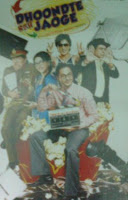
There are mainly two characters around whom the plot revolves. The first is a hindi film director, Raj Chopra, who though remains down in debts but maintains a polished appearance by his smart innovative techniques which he also employs to evade his creditors. The second is the idealistic chartered accountant Anand Pawar who starts his life by shunning any short-cut way of earning money but finds himself kicked out of his company as a result. There is also his ladylove, Neha, a drama artist cherishes her dream of making it to the silver screen. Now, both Raj & Anand seem to have one thing in common and that is they both are short of cash. So though, they can't see eye to eye in any matter yet destiny forces them to join hands in hatching a plot that apparently ensures a 100cr profit for the two. The plan was to produce a film of 5cr and taking the same amount from each of the 21 financers, each being oblivious to the other's contribution. As it is meant to be a flop and thus a 0 profit movie, the financers won't bother for their share. To carry out their plan they employ the worst script writer Ashraf Pervez on a payment of Rs1000 and the superconfident filmstar Aryan who in turn urges the two to employ his masseur as the director. This done, Raj insists Anand to consider Neha as the heroine as an actress of no experience is bound to worsen the movie.
 So with this pack of mostly inexperienced cast and totally rot crew, the joint venture of Raj and Anand promises a grand flop. But alas, the audience seems to disagree and the film make a huge hit thus dealing a crushing blow the actual plan. Raj-Anand makes it to gaol and Neha seems to drift towards Aryan. But a happy ending awaits the viewers though most of them surely will 'dhoondte reh jaaoge' (keep searching) about the moto of the film.

There are mainly two characters around whom the plot revolves. The first is a hindi film director, Raj Chopra, who though remains down in debts but maintains a polished appearance by his smart innovative techniques which he also employs to evade his creditors. The second is the idealistic chartered accountant Anand Pawar who starts his life by shunning any short-cut way of earning money but finds himself kicked out of his company as a result. There is also his ladylove, Neha, a drama artist cherishes her dream of making it to the silver screen. Now, both Raj & Anand seem to have one thing in common and that is they both are short of cash. So though, they can't see eye to eye in any matter yet destiny forces them to join hands in hatching a plot that apparently ensures a 100cr profit for the two. The plan was to produce a film of 5cr and taking the same amount from each of the 21 financers, each being oblivious to the other's contribution. As it is meant to be a flop and thus a 0 profit movie, the financers won't bother for their share. To carry out their plan they employ the worst script writer Ashraf Pervez on a payment of Rs1000 and the superconfident filmstar Aryan who in turn urges the two to employ his masseur as the director. This done, Raj insists Anand to consider Neha as the heroine as an actress of no experience is bound to worsen the movie.
 So with this pack of mostly inexperienced cast and totally rot crew, the joint venture of Raj and Anand promises a grand flop. But alas, the audience seems to disagree and the film make a huge hit thus dealing a crushing blow the actual plan. Raj-Anand makes it to gaol and Neha seems to drift towards Aryan. But a happy ending awaits the viewers though most of them surely will 'dhoondte reh jaaoge' (keep searching) about the moto of the film.
Monday, March 16, 2009
Laal Kaalo
 The first full length Bengali animation film, based on the late Girindra Sekhar Basu's (founder of Indian Psychoanalytical Society) tale of two ant kingdoms viz the red and the black probably paves the way for movies of this kind to come to the limelight for Bengali film industry. As a starter for the genre, this provides excellent animation supported by the able voice modulations of Kharaj Mukhopadhyay, Sabyasachi Chakrabarty, Biswajit Chakrabarty and others. This refreshing peace of entertainment is directed by R.D. Mallick of Elecom Fiesta who not only directs the movie in style but never includes a dull moment to the whole show. But being critical as I am, I felt the number of songs in the 80 min exceeding the necessary requirements. Barring this, this brightly coloured fun filled yet lightly moralizing picture should be given all the credit for its successful endeavor.
The story starts with peace reigning between the red and the black ant colonies near a pond. But a misunderstanding triggered by the mischief of some playful young red ants on the aged Lalburo (a close acquintance of the red King) and the haughty Kalobou (the favourite companion of the black Queen) results in the later taking offence on Lalburo which prompted the black Queen to ask the meek black King for Lalburo's head. Soon Lalburo goes missing that enrages the red King and he declares war on the blacks on the provocation of Ghoon, the evil termite who was keen on destroying the whole animal kingdom so that he can rule the world.  But this war dissapoints the red Prince, Lohit who falls in love with the black Princess Krishna and requests his father to call off the war. But the red King turns a deaf ear to Lohit and dejected, he leaves the kingdom and takes Krishna with him. Now Ghoon plays the part of a double agent and divulges the secrets of the red and the black camps to each other. He manipulates each party and also pursuades different animals like the powerful chameleon, toad, sparrow, snake and the mongoose to take part in the war for one side or the other and the stage is set for a huge battle. Now it is left to the wise spider and his two associates, the purple crabs to deliver justice, bring peace between the warring parties thus preventing the destruction of a part of the animal kingdom and bring back Lohit and Krishna from their exile.
The viewers, both young and old will definitely enjoy this fascinating story that finishes off with a strong but nice moral and is a pleasant change to the mundane tollywood productions.
 But this war dissapoints the red Prince, Lohit who falls in love with the black Princess Krishna and requests his father to call off the war. But the red King turns a deaf ear to Lohit and dejected, he leaves the kingdom and takes Krishna with him. Now Ghoon plays the part of a double agent and divulges the secrets of the red and the black camps to each other. He manipulates each party and also pursuades different animals like the powerful chameleon, toad, sparrow, snake and the mongoose to take part in the war for one side or the other and the stage is set for a huge battle. Now it is left to the wise spider and his two associates, the purple crabs to deliver justice, bring peace between the warring parties thus preventing the destruction of a part of the animal kingdom and bring back Lohit and Krishna from their exile.
The viewers, both young and old will definitely enjoy this fascinating story that finishes off with a strong but nice moral and is a pleasant change to the mundane tollywood productions.
Thursday, March 12, 2009
Chandacharit
*****Foreward
This is my 1st poem to be published! Actually it all started when one of our secretaries of the Satattar Palli Sarbojanin Durgotsab Committe hit upon the idea of ornamenting the 2008 Puja souvenir with contributions from the Palli members. As we were collecting materials for the same, I was thinking of writing a 1 page summary to reflect some feelings of the Puja days when all of a sudden it dawned upon me that if the same can be done in rhymes, the effect may be even cooler. So following moments of anxiety while searching for rhyming words, I finally made a draft of the same. A slight modification was sugested by my father and finally the whole thing was approved by my wife and parents. So, emboldened by their encouragement I went on to submit the following for the local Durga Puja souvenir for the year 2008-09.


This is my 1st poem to be published! Actually it all started when one of our secretaries of the Satattar Palli Sarbojanin Durgotsab Committe hit upon the idea of ornamenting the 2008 Puja souvenir with contributions from the Palli members. As we were collecting materials for the same, I was thinking of writing a 1 page summary to reflect some feelings of the Puja days when all of a sudden it dawned upon me that if the same can be done in rhymes, the effect may be even cooler. So following moments of anxiety while searching for rhyming words, I finally made a draft of the same. A slight modification was sugested by my father and finally the whole thing was approved by my wife and parents. So, emboldened by their encouragement I went on to submit the following for the local Durga Puja souvenir for the year 2008-09.


Monday, March 09, 2009
The Magic of Malgudi
 I've never read R.K. Narayan's work but had been fascinated by the simple yet thought provoking episodes of the popular TV serial, "Malgudi Days", and one of these, viewed sometime in the previous year inspired me to have a look into his works. But at the 2008 Calcutta Book Fair, owing to my purchase exceeding my budget and the confusing titles of the Penguin India publications, which puzzled me to choose among the abridged and the unabridged versions, I didn't go for buying one. Later I researched @ wikipedia and penguin online and so this time at the Book Fair 2009, I purchased this copy containing
- Swami and Friends
- The Bachelor of Arts
- The Vendor of Sweets
An introduction, summarising the contents by S. Krishnan, initially discouraged me as I don't like stories being told before going through the whole of it, but as I flipped though the initial chapters of Swami and Friends, I was instantly delighted to find that even if the whole story been known from the first, the author's style was simply so elegant and unique that just devouring the words can bring pleasure to the mind.
In Swami and Friends, the author has described the activites of the young schoolgoer Swami who lived in Malgudi, the fictitious Tamil town of India and barring the South Indian dishes I just couldn't find any difference between the protagonist and the ordinady school goer from any part of the country. Not only for Indian readers, this narrative will surely usher nostalgic school day memories for other readers from every part of the world.
I don't know, maybe it's my age that is responsible, but I liked 'The Bachelor of Arts' more than 'Swami' and starting from the 1st sentence, I just couldn't resist loving Chandar, the lead character. In this story the transition of a young scholar to a mature individual is brilliantly depicted and I found it quite justified in considering this to be the sequel to the first novel and while finishing it I was kept longing for the third in the trilogy, 'The English Teacher' that was sadly not a part of this volume. In fact Penguin India may seriously consider this and may reconfigure their volumes so as to maintain the continuity in the novels by Narayan.
But I think the best piece in the volume is 'The Vendor of Sweets', where the skilled penmanship of the author nicely portrays the conflict between the father and his growing son and nowhere else had I found the generation gap so decently depicted. Prior to reading this piece I had an apprehension whether this would be so much delightful as the other two as this was the 10th novel by Narayan and thus, I quite naturally & also erroneously assumed the lateness to adversely affect the writing. But as I was going through the piece I was gladly proven wrong and I'll may even say that this enchanting piece turned me into a follower of Narayan novels though the final chapters were a bit boring. The refreshingly curt way of narration adds to the splendour and the author never used too much emotion to sympathasize or alienate any particular character thus leaving it to the readers to infer about their nature. It won't be out of the place in acknowledging the fact that it was the televised edition of 'Vendor of Sweets' in the 'Malgudy Days' series that, in the 1st place, drove me to buy Narayan's novels.
The author covers all the aspects of everyday living including most of the emotions that a person, in his lifetime, goes through with the ease of a master storyteller. So his partrayal of severe misunderstandings, slight betrayals, forced hypocracies, illogical conjectures, cruel break ups, opportunistic behaviours never bring malice to the reader's mind, instead the unbiased readers can be silently amused while identifying himself/herself with the fictional characters. The realistic touch blended with humour, as was the custom of Mr. Narayan, has made the stories so much live, that I request all Indians to read this so as to understand India from a more rational and more Indian perspective.
Subscribe to:
Posts (Atom)


